ALR vs CLR Projector Screens for UST: What’s the Difference?
Understand ALR vs CLR terminology for ultra-short-throw projector screens, including what the labels do and do not tell you about real room performance.
ALR means ambient light rejecting. CLR is commonly used for ceiling light rejecting. In UST marketing, the terms often overlap because a lenticular UST screen is engineered to accept projector light from below and reject light arriving from other directions—especially above.
Why the label is not the whole specification
Two screens can both be called ALR or CLR and behave differently because their gain, optical structure, viewing cone and rejection pattern differ. The label tells you the category; the room decides whether the implementation is suitable.
UST ALR/CLR vs general ALR
A long-throw ALR screen expects projector light from a very different angle. UST screens are orientation-sensitive and designed around the steep upward path of a laser TV or other ultra-short-throw projector. Use a surface explicitly specified for UST.
What to compare instead of terminology
- Throw compatibility
- Gain
- Viewing angle / uniformity
- Independent ambient-light measurements
- Screen texture and sparkle risk
- Room lighting direction
- Fixed, drop-down or floor-rising format
Where the S Pro P lands
Vividstorm describes the S Pro P as a UST ALR/CLR lenticular screen with 0.6 gain and a 170° viewing angle. That puts it squarely in the living-room UST category rather than the generic “gray screen” category.
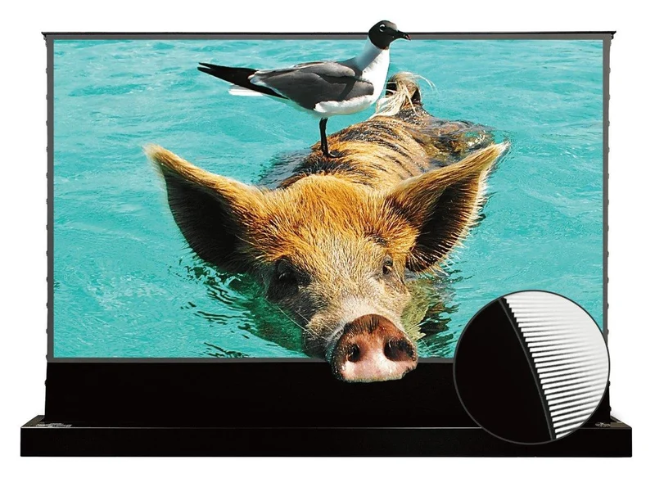
Vividstorm S Pro P
72–120″ options at the linked merchant; 0.6 gain, 170° published viewing angle, floor-rising motorized design and perforated lower border.