Vividstorm S Pro P Review: Floor-Rising UST ALR Screen
An independent, specification-led review of the Vividstorm S Pro P motorized floor-rising UST ALR/CLR projector screen, including fit, tradeoffs and alternatives.
The Vividstorm S Pro P is a specialized choice for people who want a UST-specific ALR/CLR screen that disappears into a floor case and who may need speakers placed behind the lower black border. Its differentiator is not simply “motorized”: it combines a rising, tensioned design with a published 0.6 gain, 170° viewing angle and a 0.4 mm perforated lower border.
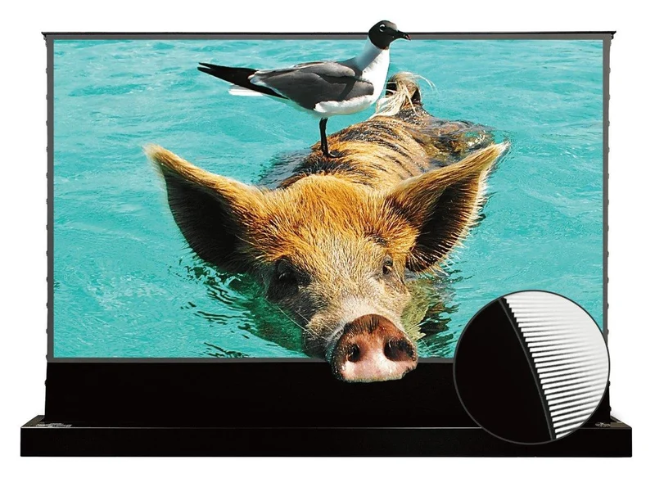
Vividstorm S Pro P
72–120″ options at the linked merchant; 0.6 gain, 170° published viewing angle, floor-rising motorized design and perforated lower border.
Who should shortlist it?
Strong fit
- Multipurpose living rooms where a fixed screen would dominate the wall.
- UST projector owners who want a lenticular ALR/CLR screen rather than matte white.
- Layouts with speakers behind the screen’s lower black border.
- Buyers who value motorized rise, remote control and trigger/automation options.
Look elsewhere first
- Standard-throw projector users.
- Rooms where a fixed frame is acceptable and simplicity matters more than concealment.
- Installations that require a fully acoustically transparent image area rather than a perforated lower border.
- Anyone who needs a size outside the merchant’s 72–120″ listing.
Published specifications that matter
| Screen type | Motorized, tensioned, floor-rising UST ALR/CLR screen |
| Merchant size range | 72″, 84″, 92″, 100″, 110″, 120″ |
| Gain | 0.6 |
| Viewing angle | 170° |
| Acoustic feature | 0.4 mm perforation in the lower black border |
| Controls | RF remote / buttons; current Vividstorm listing also describes app, voice assistant and projector-trigger control |
| Housing | Black or white options on current listings |
What 0.6 gain means in practice
Gain is not a simple quality score. A 0.6-gain UST ALR surface trades some peak brightness for light control and perceived black-level support in rooms where unwanted light is present. That is a common design choice in lenticular UST screens. Projector brightness, wall and ceiling colors, viewing position and the direction of room lighting still matter.
Why the perforated lower border is unusual
The S Pro P’s perforation is specified for the lower black border, not as a blanket claim that the entire projected image surface is acoustically transparent. That distinction matters. It can be useful when a center channel or soundbar sits behind the lower border, while avoiding the image-area compromises that can come with a fully perforated surface.
Floor-rising is a room-design decision
A floor-rising case can sit on or integrate with furniture and retract when the projector is off. This avoids a permanently visible frame but adds a motor, a long case, power requirements and the need to plan projector geometry around the cabinet and screen position. See our floor-rising vs fixed-frame guide before buying solely for aesthetics.
Merchant terms and availability
At our September 2026 check, NothingProjector displayed price-match, return/warranty and support messaging on its Vividstorm listings. These terms can change by region and over time, so verify them on the live checkout path rather than relying on a static article.
Check current price, stock & termsClosest alternatives
- NothingProjector Black Series floor-rising — similar 0.6 published gain, with a 95% ALR claim on current merchant specs.
- AWOL Vision Cinematic+ — motorized floor-rising, UST-specific and acoustically treated lower section.
- Elite Screens Kestrel CLR — floor-rising StarBright CLR surface, 101/121″ sizes and 180° published viewing angle.
- Spectra Projection Phoenix — floor-rising Vantage UST 0.7 surface.
Screen Signal verdict framework
Choose the S Pro P because its particular combination of retractability, UST ALR/CLR behavior, size availability and lower-border acoustic path fits your room—not because one headline spec is bigger. If your wall can support a permanent screen, compare fixed-frame ALR choices too; if your room is light-controlled, also consider whether you need ALR at all.