Floor-Rising vs Fixed-Frame ALR Screens for UST Projectors
Compare floor-rising and fixed-frame UST ALR screens by room design, tensioning, setup, wall use, cost and long-term practicality.
The biggest difference is not picture quality—it is what happens when the screen is off. A fixed frame permanently claims the wall. A floor-rising screen retracts into a long case and can restore the room to a more conventional living space.
| Factor | Floor-rising | Fixed frame |
|---|---|---|
| Wall use | Wall can remain free when retracted | Permanent large visual object |
| Mechanics | Motor, risers and tensioning system | Simple static frame |
| Installation | Heavy case; needs floor/furniture footprint and power | Wall mounting and precise leveling |
| Automation | Remote/trigger/app possible | Not needed |
| Long-term complexity | More moving parts | Fewer failure points |
Choose floor-rising when...
You have a multipurpose room, windows/art/TV behind the projection area, or simply do not want a permanent 100–120″ frame. This is the core use case for the Vividstorm S Pro P.
Choose fixed frame when...
The room is dedicated, you want the simplest mechanical solution, and the wall can remain permanently occupied. Fixed frames also remove the need to wait for a screen to deploy.
Do motorized screens stay flat?
Quality floor-rising models use side tensioning and support arms to maintain the screen plane, but any retractable surface adds mechanical variables. Case placement and correct height adjustment matter.
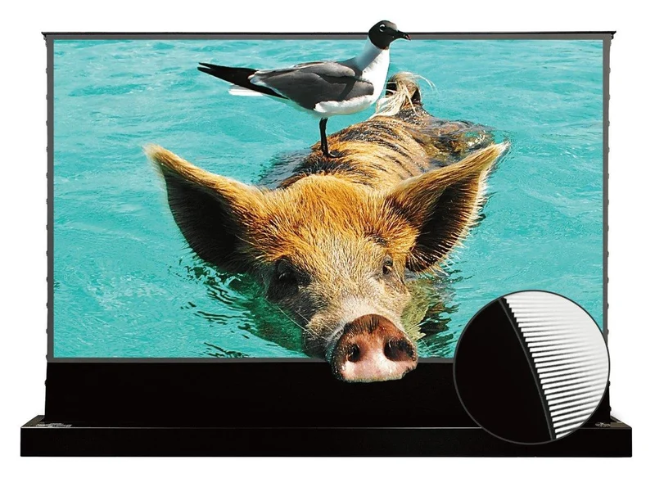
Vividstorm S Pro P
72–120″ options at the linked merchant; 0.6 gain, 170° published viewing angle, floor-rising motorized design and perforated lower border.