UST ALR Screen Guide: How to Choose a Screen for an Ultra-Short-Throw Projector
Learn how UST ALR/CLR projector screens work, what gain and viewing angle mean, and how room light, screen format and projector placement affect the result.
A UST projector fires light upward at a steep angle. A UST-specific lenticular ALR/CLR screen uses directional microstructures so more of that projector light is directed toward viewers while unwanted light from other directions is reduced. That is why a generic long-throw ALR surface can be the wrong match even if it has “ALR” in the name.
Five variables that matter most
1. Throw compatibility
Confirm the screen is designed for ultra-short throw. The optical layers are directional; orientation and throw type matter.
2. Gain
Gain describes relative reflected brightness in a specified direction. Lower-gain UST ALR surfaces can support contrast and black levels in ambient light but demand enough projector brightness. Higher gain can look brighter but may change viewing uniformity and black floor.
3. Ambient-light direction
“Ambient light” is not one thing. Ceiling light, side windows and light behind a retractable screen can behave differently. Look for room-specific evidence rather than treating a single ALR percentage as universal.
4. Viewing angle
Published wide angles are useful for broad seating, but measurement definitions can vary. Your real question is whether edge seats retain acceptable brightness and color.
5. Screen format
Fixed frame is mechanically simple. Floor-rising preserves the wall. Drop-down can clear furniture but requires overhead mounting. Choose the format before obsessing over small optical differences.
Why the Vividstorm S Pro P fits this category
Its current published spec combines a 0.6-gain UST ALR/CLR surface, 170° viewing angle and motorized floor-rising construction. The P variant also adds a perforated lower black border.
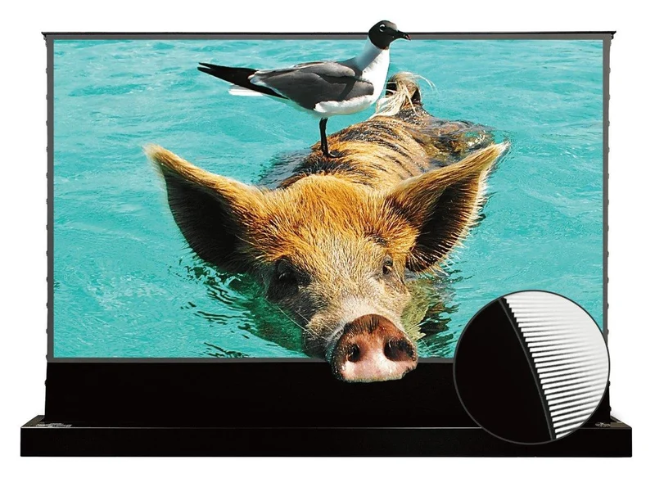
Vividstorm S Pro P
72–120″ options at the linked merchant; 0.6 gain, 170° published viewing angle, floor-rising motorized design and perforated lower border.
Common mistakes
- Buying a standard-throw ALR material for a UST projector.
- Ignoring projector placement and case depth.
- Assuming a bigger ALR percentage always means better real-room performance.
- Choosing 120″ before measuring furniture and throw geometry.
- Confusing a perforated border with a fully acoustically transparent picture area.
Next read: ALR vs CLR or floor-rising vs fixed frame.