How Motorized Floor-Rising Projector Screens Work
See how motorized floor-rising projector screens deploy, stay tensioned and integrate with UST projectors, remotes, triggers and smart-home controls.
A floor-rising screen stores the rolled material inside a horizontal case. A motor raises the surface while side supports and tensioning elements keep the image plane upright. The screen retracts back into the case when not in use.
The parts that matter
- Motor: raises and lowers the roller system.
- Side supports / scissor arms: stabilize vertical travel.
- Tab tensioning: helps keep the viewing surface flat.
- Limit settings: control the deployed height.
- Control layer: remote, physical buttons, trigger, app or smart-home integration depending on model.
Why UST makes flatness especially important
Because a UST projector sends light across the surface at a steep angle, small waves can create visible geometry distortions. That makes tensioning and correct setup more consequential than on some longer-throw systems.
Where the S Pro P fits
Vividstorm describes its floor-rising mechanism as a motorized, tensioned system with RF remote and current listings also describe app, voice and projector-trigger control.
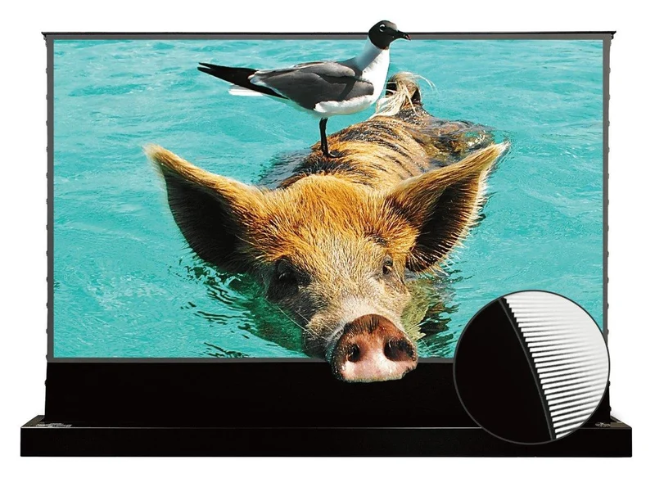
Vividstorm S Pro P
72–120″ options at the linked merchant; 0.6 gain, 170° published viewing angle, floor-rising motorized design and perforated lower border.